
Designing an outdoor kitchen for the Sarasota and Manatee climate requires material specifications built for 270+ days of sun, intense UV, salt air, and heavy rain. Maximizing Gulf Coast durability requires marine-grade stainless steel appliances, weather-proof polymer or masonry cabinetry, and non-fading natural stone like leathered granite or quartzite instead of engineered quartz.
The question for most homeowners is not whether an outdoor kitchen makes sense on the Gulf Coast. It is how to build one that holds up, looks the way they imagined it, and gets used the way they planned. Florida’s climate is generous with its outdoor living hours and hard on materials that are not specified correctly.
This guide covers both sides of that equation: what makes a custom outdoor kitchen work beautifully in Sarasota and Manatee, and how to make decisions that hold up through years of salt air, afternoon rain, and intense UV rather than just looking right on the day of installation.
Why the Gulf Coast climate changes everything about outdoor kitchen design
Most general outdoor kitchen guidance is written for climates that are nothing like the Gulf Coast, and the material and design recommendations reflect that. Building an outdoor kitchen in Sarasota is a different project from building one in the midwest or the Pacific Northwest, and treating it as an equivalent decision is how homeowners end up with countertops that fade, cabinetry that warps, and hardware that corrodes within the first couple of years.
UV intensity on the Gulf Coast is among the highest in the continental United States. It acts on certain materials in ways that are not immediately visible but become obvious over a few seasons: engineered quartz surfaces fade and lose their finish, certain paints and laminates degrade at the surface, and hardware with inadequate coating or plating begins to show corrosion before the outdoor kitchen has had time to earn its place as the favorite spot in the house.
Salt air is the other force that shapes material decisions for any outdoor kitchen within a few miles of the coast. It acts on exposed metal, on grout joints in tile surfaces, and on certain stone finishes over time in ways that only become apparent once the damage is established. Specifying marine-grade appliances, the right countertop material with appropriate sealing, and cabinetry that is genuinely designed for outdoor coastal exposure rather than just rated for light weather conditions is the difference between an outdoor kitchen that ages well and one that requires ongoing remediation.
Afternoon rain is a Florida constant from late spring through early fall, and it shapes both material choices and structural decisions. A well-positioned pergola or roof structure extends the usable days of an outdoor kitchen significantly and protects the materials underneath from direct weather exposure. Drainage at the floor level of the outdoor kitchen area matters in ways that become very clear the first time a significant rain event overwhelms a space that was not designed with water movement in mind.
All of this is context for the central point: outdoor kitchen design on the Gulf Coast is a specification exercise as much as a design one. The right materials in the right positions, built by a team that understands what Florida conditions actually do to outdoor structures over time, is what produces an outdoor kitchen that looks as good in year seven as it did in year one.
What the best outdoor kitchen in Sarasota actually includes
The elements that need to be right
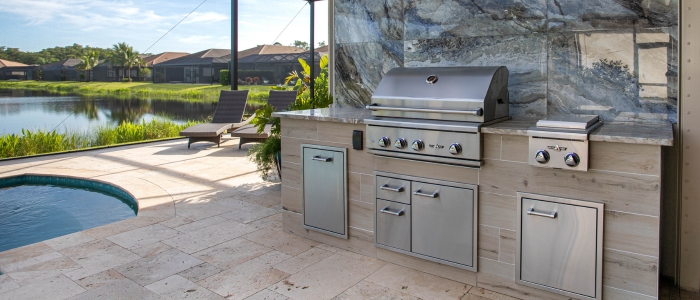
The cooking station is the center of the project, and getting it right means more than choosing a grill. A built-in gas grill appropriate for the cooking volume and style of the household, side burners for the dishes that do not work on the grill, adequate ventilation clearance, and a countertop on both sides of the cooking zone for landing hot pans and prepping food: these are the functional requirements that a well-designed outdoor kitchen meets without the cook having to adapt their cooking around the space.
Cabinetry specified for outdoor use in a Florida coastal environment is a category unto itself. The term weather-resistant covers a wide range of products, and not all of them belong in a Sarasota outdoor kitchen. Polymer cabinetry, marine-grade stainless steel, and properly specified masonry construction are the three categories that consistently hold up. Standard wood cabinetry, even treated and sealed, is not appropriate for full outdoor exposure in a humid, salt-adjacent environment. The distinction matters because cabinetry is one of the most expensive elements to replace when it fails, and it fails in ways that are not always gradual. Kirkplan’s cabinetry options include outdoor-appropriate specifications that reflect this reality rather than assuming that what works indoors translates directly outside.
Natural stone countertops are the only countertop material worth specifying for outdoor use in Florida. Granite and quartzite hold up under Florida’s UV exposure, heat, and humidity without the surface degradation that engineered quartz experiences outdoors over time. A leathered or honed granite countertop on an outdoor kitchen in Sarasota manages the reflected glare of direct afternoon sun, resists heat from the grill, and with proper sealing at installation, handles the moisture of Florida’s rainy season without absorbing it. This is not the place to value-engineer the countertop.
The full scope of outdoor kitchen services at Kirkplan covers all of these elements as part of a coordinated project rather than an afterthought.
The details that separate a good outdoor kitchen from a great one
Bar seating positioned so that guests face the person cooking rather than sitting around a table with their backs to the kitchen changes how the space functions socially. The outdoor kitchen stops being a place where one person cooks while everyone else waits and becomes a space where the cooking is part of the gathering. On the Gulf Coast, where outdoor entertaining is a genuine part of how people live, this layout decision matters more than it might seem.
Storage for outdoor cooking tools, serving equipment, and cleaning supplies housed in weather-appropriate cabinetry keeps the space organized and the experience of using it genuinely pleasant rather than improvised.
Why a well-designed outdoor kitchen is worth more than you might expect
There is a body of research that explains why people who build outdoor kitchens they genuinely enjoy using consistently describe the addition as one of the best decisions they made for their home, in terms of how it feels to live there rather than just what it does to the resale value.
Environmental psychologists Rachel and Stephen Kaplan developed Attention Restoration Theory over decades of research on how natural and outdoor environments affect human wellbeing. Their foundational work, published in The Experience of Nature: A Psychological Perspective, establishes that time spent in natural environments restores directed attention capacity, reduces mental fatigue, and produces a quality of mental rest that indoor environments cannot replicate. The more accessible and comfortable the outdoor space, the more frequently people use it, and the more they benefit from what that time outdoors does for them.
For Gulf Coast homeowners, the practical implication is straightforward. A well-designed outdoor kitchen lowers the threshold for spending time outside. When the space is comfortable, functional, and genuinely pleasant to be in, it gets used regularly rather than occasionally. The ten months of outdoor cooking weather that Sarasota and Manatee offer becomes an actual resource rather than a background fact about the local climate. Homeowners who have built outdoor kitchens they love consistently report using them far more than they expected to, and describing the change in the rhythm of daily life at home as one of the less expected benefits of the investment.
Materials that make sense on the Gulf Coast
Granite in a leathered or honed finish is the countertop specification that consistently performs best in Florida coastal outdoor kitchens. The leathered surface texture manages direct afternoon sunlight without the reflective glare that polished granite creates, resists heat from the cooking zone, and develops a patina over time that reads as warm and well-used rather than worn. Quartzite is the alternative for homeowners who want maximum hardness and heat tolerance: in many varieties harder than granite, it handles the full range of Florida outdoor conditions with minimal maintenance. Both materials are available through Kirkplan’s countertop range and can be seen in person at the showroom before any specification is finalized.
Marine-grade stainless steel for appliances is the appropriate specification for any outdoor kitchen within proximity of the coast. Standard residential stainless appliances will show corrosion in salt air environments within a few years, which creates both a maintenance problem and a visual one. The upfront cost difference between standard and marine-grade specification is significantly less than the cost of replacing appliances that have corroded prematurely.
Outdoor-rated porcelain tile for floors and vertical surfaces, in a structured or lightly textured finish for slip resistance, is the durable and low-maintenance surface specification for the parts of an outdoor kitchen that are not countertop or cabinetry. Large format tiles minimize grout lines and reduce the accumulation of salt, sand, and organic material in the joints that are one of the more persistent maintenance concerns in outdoor tile surfaces. UV-stable colors and non-porous manufacturing make porcelain the appropriate choice for any outdoor surface that will see direct Florida sun.
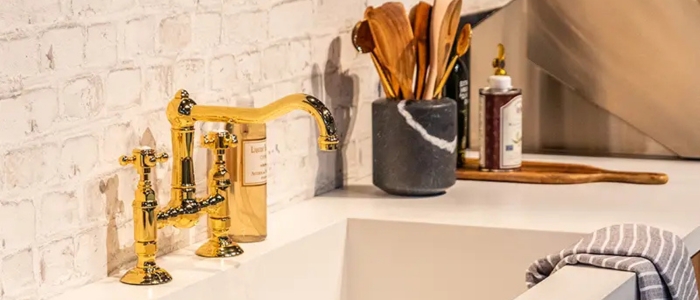
Hardware in brushed stainless, marine-grade brass, or powder-coated finishes holds up in salt air conditions. Standard brass and chrome will show corrosion and discoloration within a season or two of coastal exposure.
Coastal kitchen layout ideas for Sarasota and Manatee homes
The L-shaped layout is the most flexible configuration for homeowners who want to create distinct cooking and prep zones while keeping the space genuinely social. One arm of the L houses the grill and cooking zone; the other provides prep countertop and storage, or transitions into bar seating that faces the cook. It works in a range of outdoor space sizes and adapts well to the lanai configurations common in Sarasota and Manatee homes.
The straight-line grill station is the right scope for a first outdoor kitchen addition or for a lanai where the available width limits a more complex layout. A built-in grill, a stretch of natural stone countertop on either side, and proper cabinetry underneath: this configuration delivers the core outdoor cooking experience without requiring a large footprint or a large budget, and it can be expanded in future phases if the household’s outdoor cooking ambitions grow.
The full outdoor kitchen with covered structure, bar seating, refrigeration, and dining area is the scope that creates an outdoor room rather than just a cooking station. This is the project that changes how a home functions on a daily basis, adding a genuine second entertaining space that operates independently of the interior for most of the year. On the Gulf Coast, where the outdoor living season is as long as it is, this scope makes sense for homeowners who entertain regularly or simply want the daily experience of spending time in a well-designed outdoor space.
Maintaining a consistent material palette between the interior and exterior of the home creates a continuity that makes the overall property feel larger and more considered. Carrying the stone tone of the outdoor countertop or the cabinetry color palette through to the outdoor kitchen, rather than treating the outdoor space as a separate design exercise, produces a home where the transition from inside to outside feels seamless rather than like a shift from one design to another.
The Kirkplan process for custom outdoor kitchens in Sarasota and Manatee
Kirkplan Kitchen and Bath has been building kitchens across Sarasota and Manatee counties for over 28 years, and a meaningful portion of that work has been outdoor kitchens designed specifically for Gulf Coast conditions. The local experience matters in ways that are practical rather than abstract: knowledge of permit requirements in Sarasota and Manatee, established relationships with the subcontractors who handle the utility and structural work that outdoor kitchen projects require, and a team that has seen what works and what does not in this specific climate over more than two decades.
The process begins with a design consultation that covers cooking habits, space requirements, aesthetic direction, and budget. The goal is to understand how the homeowner actually lives and entertains outdoors so that the outdoor kitchen can be designed around that reality rather than a generic template. From consultation, the project moves through design development, a precise technical survey of the outdoor space, material selection, scheduling, and project execution.
A free in-home consultation is the right first step for homeowners who want to understand what their specific space and budget can deliver. Kirkplan Kitchen and Bath serves the full Sarasota and Manatee area and the consultation is the point where a general interest in an outdoor kitchen becomes a specific, realistic plan.
How to think about the investment
Outdoor kitchen cost varies considerably based on scope, materials, structural work, and the specific conditions of the outdoor space.
An entry-level scope, a straightforward grill station with natural stone countertop, weather-appropriate cabinetry, and basic lighting, delivers the core outdoor cooking functionality without the full investment of a more complex project. This is a legitimate scope for homeowners who are beginning to invest in outdoor living or who have a lanai that limits the footprint available.
A mid-range outdoor kitchen with covered pergola or roof structure, bar seating, outdoor refrigeration, and a more complete material specification is the scope that most Sarasota and Manatee homeowners arrive at when they have given full consideration to how they want to use the space. It is also the scope that most consistently delivers a return at resale, where outdoor living spaces are a significant driver of value in the Florida market.
A full outdoor living space with multiple cooking zones, integrated dining, landscape connection, and architectural-grade materials is a project that transforms the outdoor experience of a home in ways that affect daily life well beyond the cooking function. This is the scope for homeowners who entertain frequently, who have a strong vision for their outdoor space, or who are building or renovating a home where the outdoor kitchen is a central design element rather than an addition.
The most useful way to think about any of these investments on the Gulf Coast is in terms of daily use. It is a space that gets used continuously through the majority of the year, and the value it creates is proportional to how well it was built and how well it was designed for the people who live there.
Frequently asked questions
What makes a good outdoor kitchen for Florida’s Gulf Coast climate?
The combination of UV-stable materials, weather-appropriate cabinetry, natural stone countertops, marine-grade appliances, and some form of overhead coverage makes an outdoor kitchen well-suited to Gulf Coast conditions. Material specification is the most important decision because Florida’s UV intensity, salt air, and humidity test every surface choice in ways that other climates do not.
What countertop material is best for an outdoor kitchen in Sarasota?
Granite and quartzite are the most reliable outdoor countertop specifications for Sarasota and Manatee outdoor kitchens. Both materials are heat resistant, scratch resistant, and with proper sealing, handle Florida’s outdoor conditions without fading, degrading, or requiring significant maintenance.
Can I use engineered quartz for an outdoor kitchen in Florida?
Engineered quartz is not recommended for outdoor use in Florida. UV exposure causes surface fading and degradation over time in engineered quartz products, and Florida’s UV intensity accelerates this process relative to what the same material would experience in a less sunny climate. Natural stone is the appropriate outdoor countertop specification.
Do I need a permit for an outdoor kitchen in Sarasota or Manatee County?
Most outdoor kitchen projects in Sarasota and Manatee County require permits for gas, electrical, and structural work. Kirkplan handles the permit process as part of the project, which is one of the practical advantages of working with a contractor who has a long history of projects in the local market and established relationships with the relevant authorities.
What cabinetry holds up best in a Florida outdoor kitchen?
Polymer cabinetry, marine-grade stainless steel, and properly constructed masonry are the three categories that consistently hold up in Florida outdoor conditions. Standard wood cabinetry is not appropriate for full outdoor exposure in a humid, salt-adjacent coastal environment.
How do I maintain natural stone countertops in an outdoor kitchen?
Natural stone outdoor countertops should be sealed at installation with a penetrating stone sealer appropriate for outdoor use and resealed on a schedule appropriate to the exposure level of the surface, typically annually for outdoor kitchen applications. Cleaning with pH-neutral products and avoiding prolonged standing water on the surface are the two most important ongoing maintenance practices.